Free Online Study Site
Free practice tests for electricians preparing for state licensing exams. Updated for NEC 2026. Covers Journeyman, Master, NEC Code, EPA 608, and HVAC — no signup needed.
Prepare for your Journeyman license exam. Hundreds of NEC 2026 questions covering wiring methods, grounding, branch circuits, load calculations, and motors.
Advanced NEC code, load calculations, service entrance design, and motor controls for Master Electrician candidates.
Article-by-article NEC code tests. Updated for the 2026 National Electrical Code — from Article 100 definitions to special occupancies and energy storage.
Scenario-based NEC practice tests to sharpen your code-book skills and exam speed across all major NEC articles.
Electrical theory and HVAC electrical systems — transformers, motors, controls, and refrigeration circuits for technicians and NATE exam prep.
Practice for the EPA Section 608 refrigerant certification. Covers Type I, II, III, and Universal technician exams. 70% to pass.
Foundational electrical theory covering Ohm's Law, circuits, voltage, current, and resistance. Perfect starting point for new apprentices.
Not just what's on the test — the actual concepts each exam is testing you on.
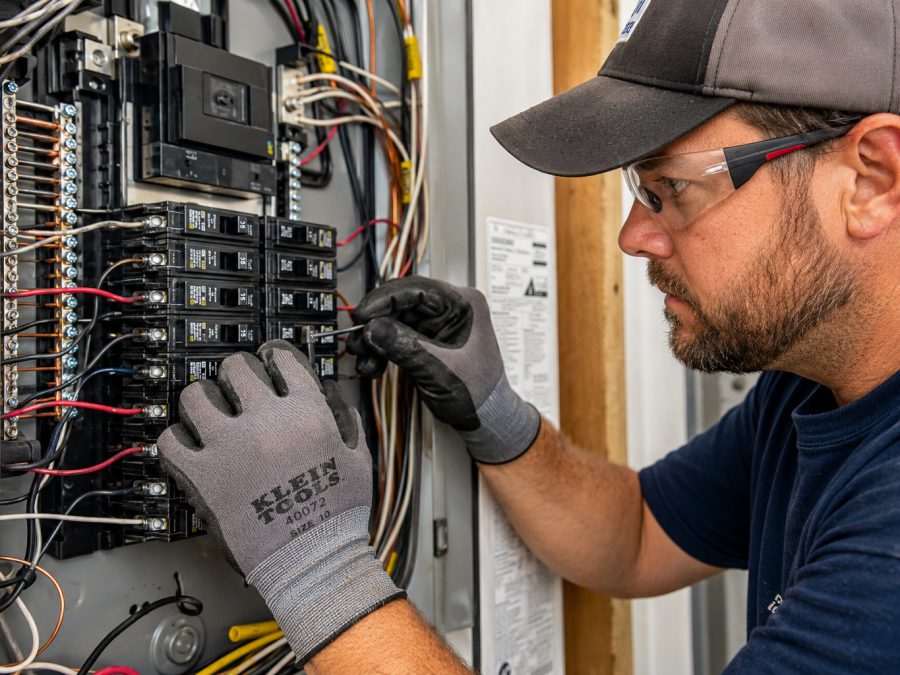
A branch circuit is the wiring that runs from the last overcurrent device — a breaker or fuse — out to the outlets, lights, or equipment it feeds. Conductor size has to match the breaker rating, not the other way around: a 20A breaker needs 12 AWG copper, not 14 AWG, because undersized wire heats up well before an oversized breaker ever trips.
Grounding is a separate concept from the neutral, even though both eventually bond to the same point at the service. The equipment grounding conductor exists purely to give fault current a low-impedance path back to the source — enough current flows instantly to trip the breaker, instead of leaving a metal enclosure energized and waiting for someone to touch it.
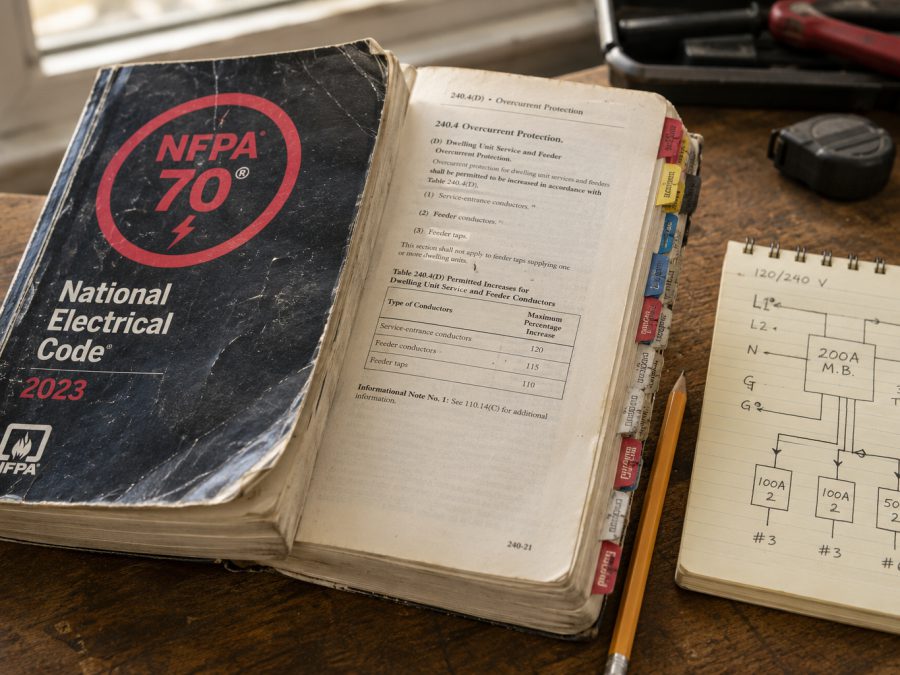
The NEC reads top-down for a reason: Chapter 1 defines terms and general rules, Chapters 2–4 cover wiring design and protection — where most exam questions live — Chapter 5 covers special occupancies, and Chapters 6–8 cover special equipment and communications. Later chapters can override earlier ones, never the reverse.
Inside an article, the general rule always comes first, exceptions after. Table 310.16 ampacity values only apply once you've confirmed insulation type, ambient temperature, and how many current-carrying conductors share the raceway — skip one of those adjustment steps and you'll read the table wrong, even if you found the right row.
A compressor pressurizes refrigerant vapor, which forces it to reject heat and condense into a liquid. An expansion device then drops that liquid's pressure so it can boil at a low temperature and absorb heat again — that's the entire refrigeration cycle, repeated continuously.
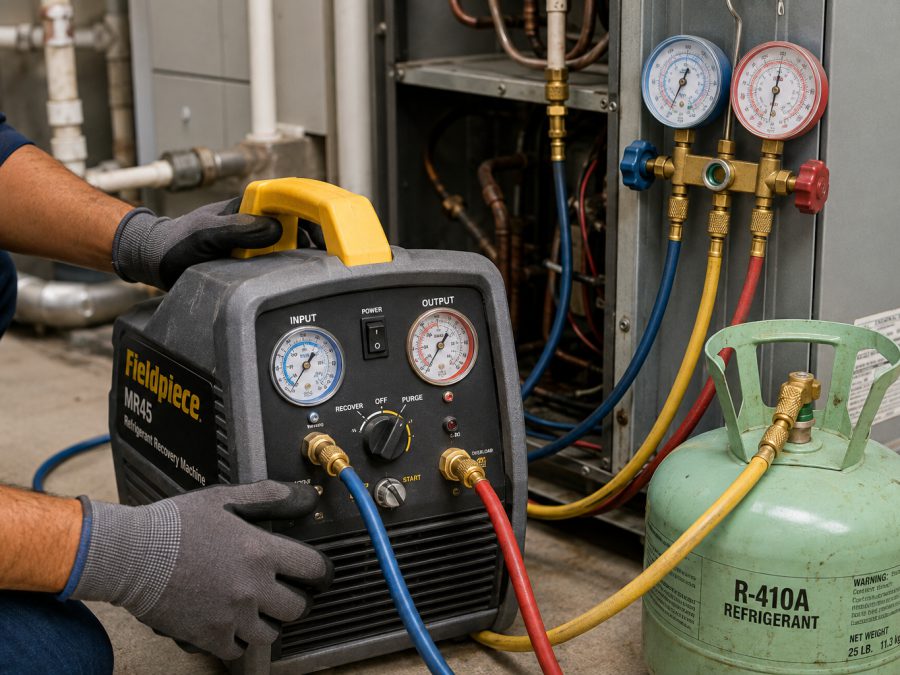
The EPA regulates handling because most refrigerants are potent greenhouse gases — ranked by GWP (global warming potential) — or ozone-depleting, ranked by ODP. Recovery equipment exists specifically to pull refrigerant out of a system into a cylinder instead of venting it to atmosphere; venting is the exact act the certification exam is built to prevent.
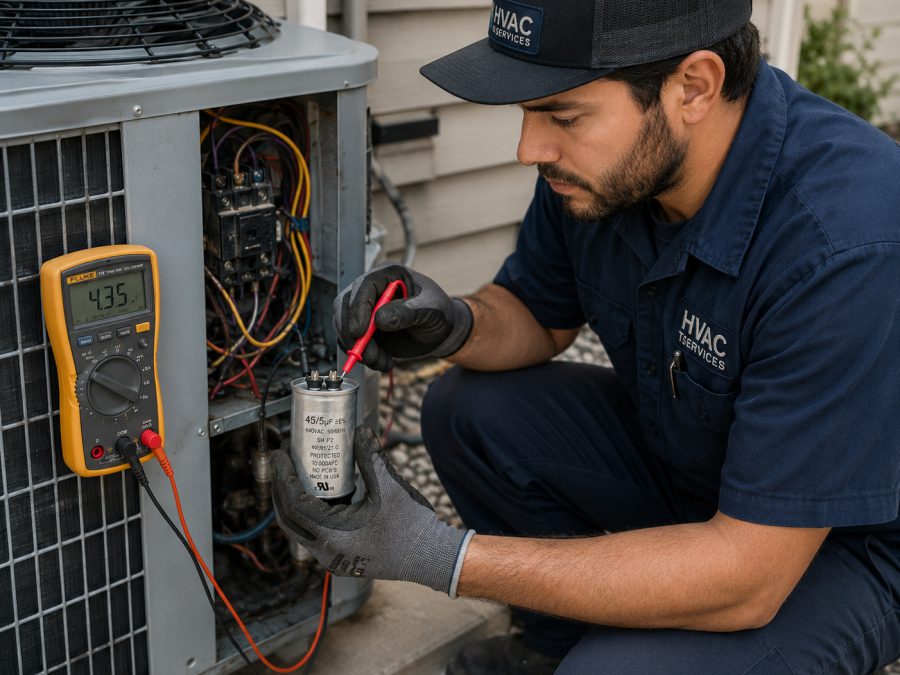
A single-phase motor can't generate rotational torque from one winding's alternating field alone — it needs a second, phase-shifted current to get moving. A start capacitor provides that phase shift just long enough to spin the motor up, then drops out; a run capacitor stays in the circuit permanently, correcting the phase angle between voltage and current to cut amp draw and heat during normal operation.
Contactors and relays exist to solve a different problem: switching a high-voltage, high-current load — a compressor or condenser fan — using a low-voltage control circuit a thermostat can safely handle.
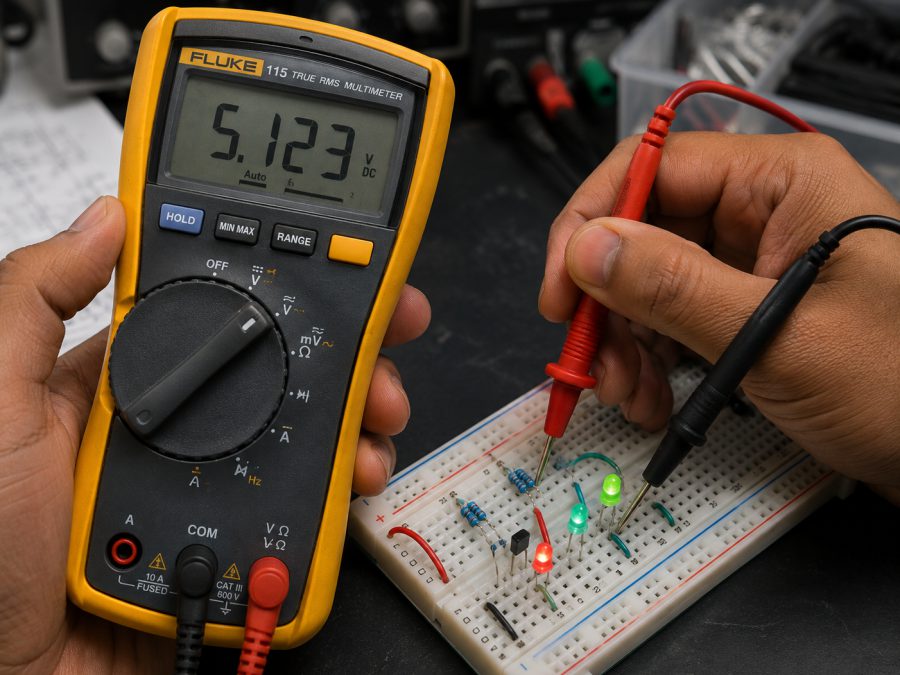
Voltage, current, and resistance are linked by one equation: V = I × R. Voltage is the electrical pressure pushing electrons through a circuit, current is how fast they flow, and resistance is what opposes that flow. Push more voltage through the same resistance and current rises proportionally; add resistance for a given voltage and current drops.
The relationship changes with circuit type: in a series circuit, current is identical through every component while voltage divides across them; in a parallel circuit, voltage is identical across every branch while current divides. Nearly every load calculation an electrician does traces back to this.
In-depth articles with fully worked examples — box fill, voltage drop, motor circuits, and more.
A deep, plain-English walkthrough of voltage drop calculations — why voltage drop matters, the VD = (2 x K x L x I) / CM formula explained from first principles, and 6 fully worked real-world examples.
Read guide NEC Code ExplainedA deep, plain-English walkthrough of NEC Article 300 — the general wiring method rules that govern every conduit run and cable installation, plus how EMT, IMC, RMC, PVC, NM, MC, AC, and UF actually compare in the field.
Read guide NEC Code ExplainedA clear, from-first-principles explanation of how electrical service works — overhead vs underground, the six-disconnect rule, grounding at the service, and worked examples sizing both a residential and a commercial service.
Read guide NEC Code ExplainedA deep, plain-English walkthrough of NEC Article 430 motor circuit rules — why motors need special sizing math, and how to size branch circuit conductors, short-circuit/ground-fault protection, and overload protection with fully worked examples.
Read guide Electrician Math ExplainedLearn why box fill limits exist, how the volume-allowance method works for conductors, devices, clamps, and grounds, and walk through six fully worked examples for choosing the right box size.
Read guide Electrician Math ExplainedLearn why conduit fill limits exist, how the fill-percentage rules work, and how to size conduit correctly with six fully worked examples covering EMT, PVC, mixed conductor sizes, and pulling new circuits into existing raceways.
Read guideNo account needed. Pick your exam type, take a test, and see your score right away.
Choose Journeyman, Master, NEC Code, EPA 608, or your state exam. All tests are free — no email, no payment, no account needed.
Multiple choice, just like the real exam. Take as many as you want. Your progress saves automatically — close the tab and come back any time.
After each question, see why your answer was right or wrong. Every explanation includes the NEC article number so you know exactly where to study in your codebook.
This site was built to give electricians and HVAC technicians a free, reliable place to prepare for their licensing exams. Every question is written based on the National Electrical Code and checked against real state exam outlines before it goes live.
We update our tests when the NEC changes. NEC 2026 is now the current edition and our content is being updated to reflect it. New practice tests are added regularly. All tests are free, forever.
Get notified when new practice tests are added — no spam, unsubscribe any time.
Feedback from licensed and aspiring electricians who used these tests
"The code application questions for master level are tough and they should be. A few of the questions I felt were worded a bit ambiguously but that might be realistic for how the actual exam reads. Good resource for advanced prep."
"Overcurrent protection is no joke on the real exam and this test gives you alot of reps on it. Took me three tries before I was scoring above 80%. Once I was I felt ready. Good stuff."